10 Snack Vending Machine Buying Tips for Global Buyers

Buying a Snack Vending Machine for international operations requires more than comparing prices and screen sizes. Buyers must assess product capacity, payment compatibility, temperature control, service access, and local operating conditions. A machine installed in a Singapore office faces different humidity, voltage, and consumer preferences than one placed in a European railway station.

Market data shows why this category deserves careful evaluation. Grand View Research estimates that the global vending machine market reached approximately USD 21.84 billion in 2023, with strong growth expected through 2030. Fortune Business Insights also projects continued expansion, driven by cashless payments, automated retail, and demand for convenient food access. These estimates use different market definitions, however. The numbers are useful, but not absolute.

NAMA industry reports highlight the importance of telemetry, digital payments, product variety, and reliable field service in modern vending operations. These features can improve sales visibility and reduce unnecessary site visits. Yet technology alone does not guarantee profitability. A beautiful touchscreen cannot compensate for poor foot traffic or delayed spare parts.

This guide presents ten practical buying tips for global buyers. It focuses on real purchasing risks, including customs documentation, electrical standards, warranty coverage, food safety controls, and replacement-part availability. Buyers should request test videos, energy data, payment certifications, and references from similar markets. Small details matter. A jammed spiral can stop a sale. A weak service agreement can stop an entire route.

The best decision may not be the cheapest machine. It should fit the location, product mix, regulations, and long-term maintenance plan. Mistakes still happen, even with careful research. The goal is to make them fewer, cheaper, and easier to correct.
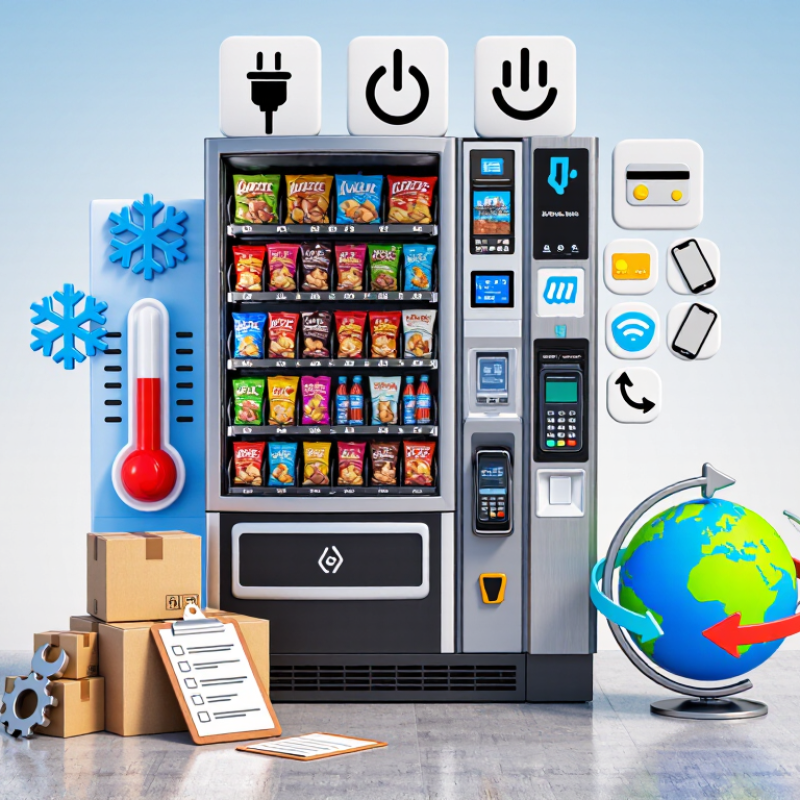
10 Snack Vending Machine Buying Tips for Global Buyers

Market Sizing: Grand View Research Forecasts 10.7% Vending CAGR to 2030

Grand View Research forecasts a 10.7% compound annual growth rate for the global vending machine market through 2030. That figure signals expanding demand, but it does not guarantee profit in every location. A careful buyer should size demand locally. Count daily foot traffic, nearby food options, operating hours, and seasonal changes. My early estimates were too optimistic. Empty offices damaged the sales forecast.

Use ten practical checks before ordering. Match the machine’s capacity to expected sales. Choose snack spirals that fit local package sizes. Confirm voltage, plug standards, and climate performance. Ask about cooling requirements in hot regions. Review payment options, including cashless systems and local currencies. Check security features, lighting, and impact-resistant panels. Inspect energy consumption carefully.

Service access matters more than attractive screen features. Confirm spare-part availability, remote diagnostics, warranty terms, and technician response times. Calculate the full cost, including shipping, taxes, installation, replenishment labor, electricity, and payment fees. Also verify local safety, electrical, accessibility, and consumer-protection requirements. Requirements vary widely.

A pilot can reveal uncomfortable truths. Place one unit for four to eight weeks, then record hourly sales, rejected payments, spoilage, and service calls. Compare products, not assumptions. A premium location may still need smaller portions and lower prices. Forecasts guide investment, while real transaction data should control the final purchase.
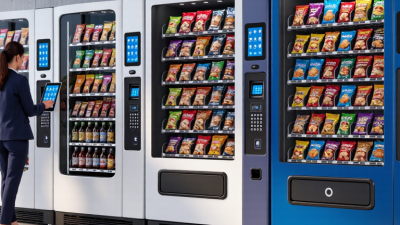
Capacity Planning: Compare 30–50 Selections and 150–400-Item Load Limits

Capacity planning starts with two numbers: selections and total load.

A machine offering 30–50 selections can cover core snacks, drinks, and several local preferences. Its 150–400-item capacity determines how often operators must refill it. NAMA’s 2023 State of the Industry report valued U.S. vending sales at about $27.8 billion, showing a large but highly location-dependent market. The report is U.S.-focused, so global buyers should avoid copying its averages blindly.

A practical example helps.

Suppose a machine holds 300 items across 40 selections. If one popular snack sells 18 units daily, that slot may need replenishment every two or three days. Slow-moving products can remain untouched for weeks. That gap matters. Review sales by selection, package size, and temperature sensitivity before choosing the cabinet. A 400-item machine sounds efficient, but excess stock may expire or lose quality in warm locations.

Field testing is more reliable than a spreadsheet alone.

Place 30–50 selections near offices, schools, transport points, or hospitals, then measure hourly demand for four weeks. Circana’s 2024 snack industry reporting identifies continued demand for convenient, portioned products, but preferences vary by country and channel. Use adjustable spirals and mixed slot sizes where possible.

My own planning mistake would be treating every selection equally; real buyers usually concentrate on a small group of familiar products. Recheck the mix monthly. Forecasts are useful, not perfect.

Compliance Checks: Verify UL 541, EN 60335-2-75, and ADA 48-Inch Access

When buying a snack vending machine overseas, compliance should guide the shortlist. UL 541 is relevant for refrigerated vending equipment in the United States. Request the complete test report, not only a certificate number. Check the exact model, voltage, refrigerant system, and production version. A document for a similar machine may not protect your purchase.

For European markets, review EN 60335-2-75 for commercial dispensing appliances. Confirm that the report covers electrical safety, temperature control, insulation, and accessible moving parts. Ask whether testing applies to the finished machine. Components may have separate approvals, but the assembled unit still needs evaluation. This detail is often overlooked.

Access needs a physical inspection. ADA guidance commonly requires operable controls within a 48-inch maximum reach range. Measure the payment area, product selection buttons, and pickup opening from the finished floor. Leave clear space for a wheelchair approach. Do not rely on drawings alone. A real site check can reveal a raised curb, a narrow aisle, or glare on the screen. Small failures create expensive retrofits. I have found compliance files clear enough to pass a desk review, yet incomplete for installation planning. That is an uncomfortable gap. Ask for current declarations, installation limits, maintenance instructions, and local approval requirements before paying the balance. If the supplier avoids precise answers, pause the order.

10 Snack Vending Machine Buying Tips for Global Buyers - Compliance Checks: Verify UL 541, EN 60335-2-75, and ADA 48-Inch Access
Tip Buying Dimension Recommended Verification Data Relevant Requirement or Benchmark Documents or Evidence to Request Buyer Action
1 Electrical safety certification Confirm that the complete vending-machine model, including refrigeration, controls, wiring, and payment hardware, has been evaluated for the destination market. UL 541
Applicable to electric commercial vending machines in the relevant North American market.
Current certificate, certification number, test report, product model list, and certification conditions. Match the certificate model number with the exact machine configuration.
2 European electrical and mechanical safety Verify that the machine is assessed as a commercial dispensing appliance and that applicable electrical, thermal, mechanical, and abnormal-operation tests are covered. EN 60335-2-75
Particular requirements for commercial dispensing appliances and vending machines.
EU Declaration of Conformity, applicable test report, technical file summary, and product photographs showing the tested configuration. Confirm that the report covers the intended voltage, refrigerant system, doors, shelves, and payment equipment.
3 Accessible operating height Place the highest frequently used control, payment interface, product-selection button, and accessible display within a maximum forward reach of 48 inches above the finished floor. ADA 48-inch access
ADA reach-range provisions generally use 48 inches as the maximum unobstructed forward reach; site conditions can affect the applicable limit.
Dimensioned elevation drawing, control-panel measurements, installation instructions, and accessibility review records. Measure the installed machine, not only the shipping or cabinet dimensions.
4 Clear floor and wheelchair approach Provide an unobstructed approach and operating area. A commonly used accessible maneuvering reference is approximately 30 by 48 inches for a clear floor or ground space, subject to local requirements. Check the applicable accessibility code for the installation country, building type, turning space, reach direction, and obstructions. Installation layout, floor-space diagram, mounting details, and site survey checklist. Do not treat cabinet compliance as sufficient if the surrounding floor area blocks access.
5 Electrical input and plug configuration Specify rated voltage, frequency, phase, maximum current, plug type, circuit protection, and standby power before ordering. Common markets use approximately 100–127 V or 220–240 V AC at 50 or 60 Hz; the exact rating must be selected for the destination country. Nameplate artwork, wiring diagram, electrical-load schedule, plug specification, and installation manual. Require a destination-specific nameplate and power cord rather than relying on an adapter.
6 Temperature and product suitability For refrigerated snacks, verify the controlled cabinet range, recovery time after door opening, temperature display accuracy, and alarm functions. Use the product maker’s validated operating range; chilled food commonly requires controlled storage at or below 5°C in many food-safety systems, while local rules may differ. Temperature-mapping report, calibration records, alarm test results, refrigeration specifications, and cleaning instructions. Separate ambient snack models from refrigerated or frozen models in the purchase specification.
7 Capacity and package compatibility Record usable selection count, shelf pitch, maximum package dimensions, product weight range, and delivery mechanism type. Use actual package measurements, including width, height, depth, flexible packaging, and irregular shapes. Advertised capacity varies by product mix. Capacity chart, shelf drawings, spiral or elevator dimensions, sample-product test report, and product loading guide. Test every intended package size through the actual dispensing column before final approval.
8 Payment and connectivity compatibility Define supported payment methods, currency, contactless standards, cash handling, receipt options, remote monitoring, and network requirements. Payment equipment must comply with local payment, privacy, cybersecurity, radio, and accessibility rules; requirements vary by country and operator. Payment-terminal certifications, network protocol sheet, data-processing terms, cybersecurity update policy, and offline-transaction procedure. Confirm who supplies, activates, updates, and supports payment hardware after installation.
9 Environmental and installation conditions Check permitted ambient temperature, humidity, altitude, indoor or outdoor rating, ventilation clearance, floor loading, anchoring, and noise level. Use the manufacturer’s tested operating limits. Outdoor placement may require weather protection, corrosion resistance, drainage, and additional electrical protection. Installation manual, environmental rating, heat-rejection data, anchoring drawing, floor-load information, and noise test data. Approve the site only after checking ventilation, power, drainage, security, and service access.
10 Import, labeling, and after-sales support Prepare country-specific labels, manuals, safety markings, customs classification, warranty terms, spare-parts list, and service response targets. Electrical marking, energy, refrigerant, packaging, recycling, language, and importer obligations differ by destination market. Label artwork, multilingual manual, packing list, commercial invoice data, warranty policy, spare-parts catalog, and service-level agreement. Make documentation, spare parts, training, and remote technical support contractual deliverables.
Compliance standards and accessibility rules can vary by country, installation environment, product category, and edition of the applicable standard. Certification should be verified for the exact model and configuration being purchased.

Payment Readiness: Use Worldpay’s 2023 50% Digital-Wallet Share Benchmark

When buying a snack vending machine for global locations, examine payment readiness before exterior design. A 2023 global payment report recorded digital wallets at about 50% of transaction share. That benchmark changes the machine’s requirements. Do not treat cash as the default.

Choose a payment module that supports mobile wallets, contactless cards, and local currencies. Confirm whether it works with weak signals and temporary network loss. A customer may stand beside the machine in a busy station, holding a phone with 8% battery. The screen should show approval quickly and clearly. Keep a physical payment option where local habits still demand it. This balance matters.

Ask the supplier for transaction logs, encryption details, refund controls, and software update procedures. Request a live demonstration, not only a sales sheet. Test a small purchase, a declined payment, and a cancelled selection. Test both too. One overlooked issue is receipt access. Some buyers need digital receipts, while others still prefer paper records. Service fees can also reduce margins, especially for low-priced snacks. Review the total cost per transaction before approving a fleet. My own practical caution is simple: a modern wallet reader can still fail in a crowded venue. Plan offline rules, visible support instructions, and a backup payment path. Reliability is measured during failures.

Lifecycle Costs: Budget Energy, Connectivity, and Service for 7–10 Years

A snack vending machine should be priced across seven to ten years, not only by purchase cost. The U.S. Department of Energy reports that refrigeration can consume 40–60% of a food retailer’s electricity. A poorly insulated cabinet can quietly drain cash every night. Ask suppliers for measured kWh per day, tested at realistic temperatures and door-opening rates.

For example, 2 kWh daily consumption equals 730 kWh annually. At USD 0.18 per kWh, energy costs reach about USD 131 yearly, or over USD 1,300 across ten years before tariff increases. Real sites vary. That estimate may be too optimistic. Include local electricity prices, seasonal heat, lighting, and standby consumption in your worksheet. The European Commission’s ecodesign rules also emphasize declared annual energy consumption for refrigerated equipment.

Connectivity deserves its own line. GSMA Intelligence forecasts 34.4 billion IoT connections by 2030, but connectivity is never truly free. Budget the modem, data plan, platform subscription, security updates, and replacement SIM. Then price service visits, travel, payment-device support, refrigeration repairs, and spare parts. The International Energy Agency states that efficiency improvements could deliver more than one-third of the emissions reductions needed by 2030. A remote alert may prevent one spoiled inventory event, but only if someone responds quickly. Request a seven-year service schedule, response times, parts availability, and renewal fees in writing.

10 Snack Vending Machine Buying Tips for Global Buyers

Lifecycle Costs: Budget Energy, Connectivity, and Service for 7–10 Years

This planning benchmark estimates operating costs at USD 762 per machine per year, or USD 7,620 over ten years, excluding the purchase price, shipping, installation, taxes, and payment-processing fees.

Assumptions: electricity use of 3.5 kWh per day at USD 0.15/kWh, cellular connectivity of USD 10 per month, and preventive maintenance plus ordinary repairs of USD 450 per year. Actual costs vary by climate, local utility rates, network contract, machine configuration, usage, and service distance.